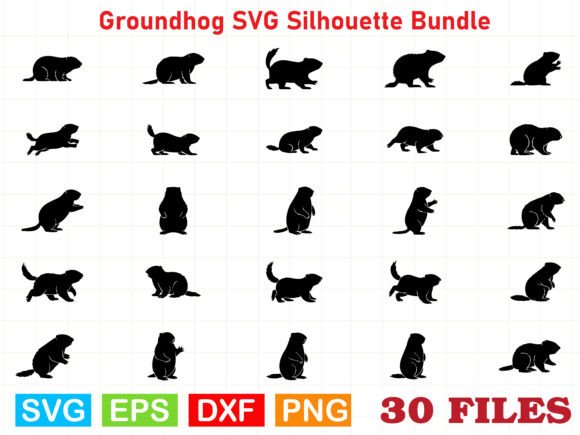
Groundhog SVG Silhouette Bundle
A Groundhog That Actually Works in Stitch—Not Just on Screen
Let’s be real: I opened the Groundhog SVG Silhouette Bundle expecting another charming-but-fragile woodland motif—cute for a digital mockup, awkward once stitched. Instead, I found something quietly confident: clean negative space, intentional weight distribution, and a silhouette that holds its shape whether scaled to 2 inches or 5. It’s not overly detailed—no tiny claws, no fur texture, no fussy ears—but that’s the point. This is an embroidery-first illustration, not just a graphic repurposed for stitch.
First Impressions: Mood, Shape, and Real-World Fit
The bundle feels grounded (pun intended) and gently playful—more “rustic charm” than “cartoon mascot.” Its rounded head, compact body, and subtle upward tilt give it quiet personality without leaning into kitsch. As an Illustrations asset, it avoids clutter; as a Graphics file, it respects vector integrity. I immediately pictured it on a linen tea towel for a small-batch kitchen boutique—simple, seasonal, and unmistakably handmade.
What Happened When I Embroidered It on a Cotton Tote Bag?
I used it for a custom embroidered tote bag for a local nature-themed baby shower gift. Hooped medium-weight cotton canvas with tear-away + light cutaway stabilizer. At 3.2 inches wide, the groundhog held crisp edges across all curves—the jawline stayed sharp, the belly curve didn’t blur, and the tail tapered cleanly. No floating stitches. No thread nesting. The satin stitch along the outer edge gave it presence without stiffness, and the fill stitch inside stayed breathable—not dense enough to crack after washing, but solid enough to read at arm’s length.
Where It Shines (and Where to Pause)
- Custom apparel: Works beautifully on sweatshirts and crewneck tees—especially when placed left-chest or centered on the back. The silhouette reads clearly even with slight fabric stretch.
- Baby embroidery: Ideal for onesies and burp cloths. Its soft proportions feel age-appropriate and gentle—not too bold, not too busy.
- Embroidered patch: Clean outline makes it patch-ready. Trimmed edges stay tidy, and the shape lends itself well to heat-seal or sew-on backing.
- Holiday embroidery: Fits seamlessly into February-themed merchandise—think “Groundhog Day” aprons, mugs (as a printable mockup), or nursery decor for winter-born babies.
- Small shop product: Adds consistent, recognizable character to a craft business lineup without demanding complex digitizing.
Use With Care On…
This isn’t a one-size-fits-all embroidery file. It performs best when matched thoughtfully to material and method:
- Small hoop sizes (under 3 inches): Scale down only to ~2 inches. Below that, the tail and ear details start to compress—still legible, but less expressive.
- Textured fabrics (like terry cloth or bouclé): Use extra stabilizer and consider simplifying the fill stitch density if your machine allows. The design’s openness helps, but texture can still swallow fine lines.
- Thin or stretchy fabric (e.g., lightweight jersey): Avoid direct placement without proper cutaway backing—this silhouette relies on clean edges, which stretch can distort.
- Dark fabric: Test thread contrast first. A charcoal gray groundhog on navy works; black on black disappears. Stick to matte thread for subtlety, or go bold with cream or mustard for visibility.
- Curved surfaces (caps, curved pillow covers): The shape adapts well—but avoid placing it too close to seams or brims where distortion occurs. Center-front on a cap? Yes. Right at the bill curve? Not ideal.
How It Shapes Perception—Before and After Stitching
Customers don’t buy silhouettes—they buy feeling, trust, and intention. The Groundhog SVG Silhouette Bundle delivers that. It reads as considered, not generic. When stitched onto a handmade pillow cover or boutique sweatshirt, it elevates perceived value—not because it’s flashy, but because it’s resolved. No jagged corners. No visual noise. Just a clear, calm, cohesive shape that says, “This was made with care.” For Etsy sellers and craft fair vendors, that quiet professionalism builds buyer engagement faster than any trend-driven graphic.
Practical Embroidery Designer Notes
- Always test the Groundhog SVG Silhouette Bundle on scrap fabric first—especially if pairing with new thread colors or stabilizers.
- Check stitch density in your embroidery software. If it’s unusually high, reduce fill density slightly—this design doesn’t need heavy coverage to read well.
- Confirm hoop size compatibility before digitizing or purchasing. Some versions may include multiple sizes; others assume standard 4x4 or 5x7.
- Inspect small details at actual stitch scale—zoom in on the tail tip and ear curve. They should remain distinct, not merge into a blob.
- Test in black-and-white mockups. Does it hold contrast against both light and dark backgrounds? That tells you how versatile your finished product will be.
- Verify licensing before selling finished items or digital embroidery files. Since the listing mentions commercial use (“ideal for prints, t-shirt designs…”), confirm whether resale of stitched goods or redistribution of the SVG is permitted.
- Match stabilizer to fabric—not just weight, but behavior. A waffle-weave tea towel needs different support than a smooth cotton poplin.
Final Thought: A Design That Serves the Project, Not the Other Way Around
The Groundhog SVG Silhouette Bundle doesn’t shout. It settles in—on a baby onesie, a market tote, a holiday kitchen towel—and belongs. It’s proof that strong embroidery design isn’t about complexity—it’s about clarity, cohesion, and context. If you’re curating design assets for a craft business, building a seasonal collection, or stitching personalized gifts that land with warmth and sincerity, this is one silhouette worth keeping within easy reach.