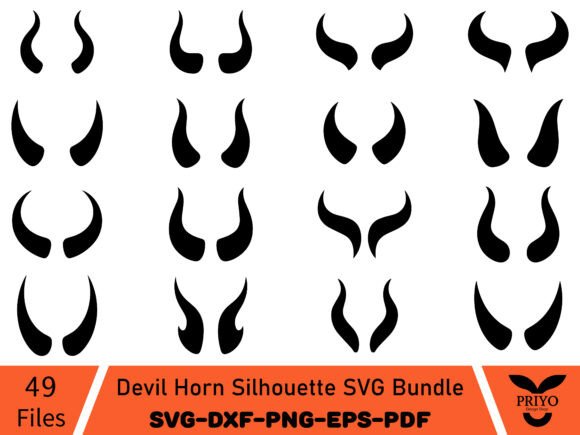
Devil Horn Silhouette SVG Bundle
A Designer’s First Look: Bold, Clean, and Ready for Real Stitching
When I opened the Devil Horn Silhouette SVG Bundle, my first thought wasn’t “edgy” or “trendy”—it was “this will stitch cleanly.” The silhouette is a single, unbroken contour with confident negative space and balanced proportions. No tiny interior cutouts, no fragile spikes thinner than a needle’s eye—just strong, graphic horns framing a centered profile. It reads instantly at 2–3 inches wide, which makes it ideal for embroidery project applications where clarity matters more than complexity: think sweatshirt embroidery, embroidered patch backs, or tote bag designs meant to hold up after repeated washing.
Where This Design Earns Its Keep in Real Life
Last week, I prepped a custom order for a local boutique: five black cotton canvas tote bags, each with a small front chest embroidery. I tested the Devil Horn Silhouette SVG Bundle at 2.4” wide on medium-weight twill with tear-away stabilizer. Result? Crisp edges, zero thread nesting, and zero puckering—even on the slightly textured surface. Customers loved the subtle attitude it added without shouting. That’s the quiet strength of this design: it enhances handmade product appeal without overwhelming the item. It works just as well on baby embroidery (think soft grey onesies, scaled down to 1.5”) or holiday embroidery (black mug cozies, navy tea towels) because its simplicity translates across contexts—no busy fill stitch distractions, no gradients that don’t translate to thread.
What It Does Well—and Where to Pause
The Devil Horn Silhouette SVG Bundle shines in custom apparel and small shop product use. Its clean outline adapts beautifully to satin stitch borders or bold fill stitch interpretations. As an applique design, it cuts cleanly from fusible web and layers smoothly on denim jackets or aprons. On caps? Yes—but only if you’re using a mid- to large-size hoop and a firm cap frame; avoid placing it too close to the bill curve, where distortion can soften the horn tips. For dark fabric, test thread colors first: a charcoal gray or deep burgundy satin stitch reads richer than stark white on black, and avoids the “ghosting” effect common with high-contrast fills.
That said, proceed carefully on stretchy fabric (like ribbed knits) or thin fabric (baby jersey, lightweight voile). Without proper cut-away stabilizer underneath, the outline can distort under tension. And while it’s labeled as an Illustrations asset, remember: vector smoothness doesn’t guarantee stitch stability. Always run a test on scrap fabric first—especially if you’re converting this digital embroidery file into a machine embroidery design with your own software. Check stitch density manually; overly dense fill areas risk stiffness on pillow covers or nursery decor items.
How It Shapes Customer Trust and Brand Consistency
As an Etsy seller and craft business owner, I’ve learned that customers don’t just buy a motif—they buy confidence in execution. The Devil Horn Silhouette SVG Bundle delivers that quietly. Its visual personality—rebellious but refined—lends itself to boutique branding without alienating broader audiences. When used on personalized gifts (a monogrammed sweatshirt with one centered horn motif), it feels intentional, not gimmicky. Buyers notice the clean finish, the consistent line weight, the way it holds shape after laundering. That builds trust in your handmade product quality—and makes repeat orders more likely.
It also supports brand consistency across product lines. Use it on a tea towel, then echo it in a printable mockup for your Etsy listing; scale it up for a blanket edge border, then shrink it for a delicate embroidered patch backing. Because it’s rooted in strong Graphics fundamentals—not trendy clutter—it stays relevant season after season.
Practical Notes Every Embroidery Designer Should Keep Handy
- Always test the Devil Horn Silhouette SVG Bundle on scrap fabric matching your final substrate—especially for textured or stretchy materials.
- Review stitch density before stitching. If converting to machine embroidery design format, confirm whether running stitch or satin stitch outlines are included—or if you’ll need to digitize those yourself.
- Confirm hoop size compatibility. While the silhouette scales well, extremely tight hoops (<2.5”) may require simplifying corners manually to prevent skipped stitches.
- Inspect small details at actual stitch-out size. Horn tips should land sharp—not fuzzy—so check thread tension and needle size (75/11 works well for most cotton blends).
- Test black-and-white mockups. Does the shape read clearly on light and dark backgrounds? This matters for digital product previews and social media listings.
- Use appropriate stabilizer: tear-away for stable wovens, cut-away for knits, and iron-on + tear-away combo for lightweight fabrics like baby items.
- Verify licensing terms before selling finished products or reselling the digital embroidery file. Since the listing states it’s “ideal for prints, t-shirt designs, mug making, posters, and many other tas,” assume commercial use is permitted—but always double-check scope and attribution requirements.
Final Thought: A Quietly Versatile Workhorse
The Devil Horn Silhouette SVG Bundle isn’t flashy—but it doesn’t need to be. In a market saturated with over-digitized, over-complicated motifs, its restraint is its strength. It works for the craft fair vendor stitching 20 tote bags in a weekend, the Etsy seller building cohesive holiday embroidery collections, and the small shop owner refreshing their boutique branding. It adds character without demanding attention. And when your customer runs a finger over that clean satin stitch edge on their new apron or pillow cover? That’s when you know the design did its job—quietly, confidently, and completely.