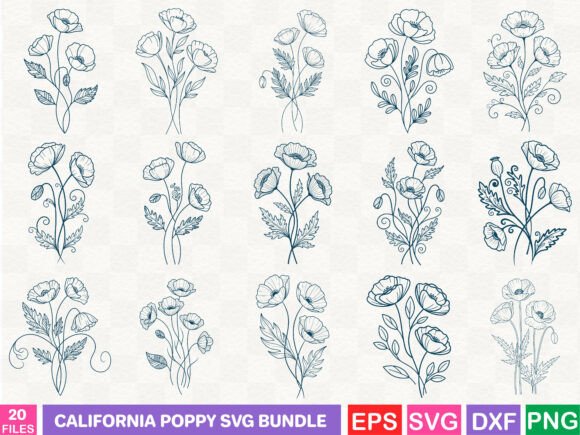
California Poppy SVG Bundle
A Designer’s First Look: Light, Lively, and Just Detailed Enough
When I opened the California Poppy SVG Bundle, my immediate thought wasn’t “pretty”—it was “practical.” The illustration carries that unmistakable West Coast warmth: open petals, gentle curves, a subtle nod to botanical accuracy without overloading on veins or micro-details. It feels hand-drawn but clean—ideal for an embroidery file that needs to translate well into stitch. As an illustrator who’s converted hundreds of vector graphics to machine embroidery designs, I appreciate how this one avoids tight clusters, overlapping lines, or fragile stem connections. That matters—especially when you’re stitching on a curved cap brim or a stretchy baby onesie.
Real Project Test: Embroidering a Linen Tote for a Local Botanical Boutique
Last week, I used the California Poppy SVG Bundle to create a limited-run embroidered tote for a small shop launching a native-plant gift line. We chose natural linen—a fabric with visible weave and low stretch—and paired it with ecru thread on the front panel. The result? Crisp satin stitch petals, smooth fill-stitch centers, and stems that held their shape without puckering. Customers noticed the design immediately—not because it shouted, but because it felt intentional, grounded, and quietly confident. That’s the value of a well-balanced illustration: it elevates a handmade product without competing with its function.
Where This Design Shines (and Where It Needs Thought)
- Custom apparel: Works beautifully on sweatshirt sleeves and t-shirt chest placements—especially when scaled between 3.5"–4.5". The open negative space lets fabric breathe, reducing stabilizer visibility.
- Baby embroidery & nursery decor: Soft edges and organic flow suit onesies, burp cloths, and pillow covers. No sharp angles or dense fill areas that could irritate delicate skin.
- Embroidered patch potential: With minor cleanup (removing stray anchor points), it converts cleanly to a sew-on or iron-on patch—great for craft fairs or Etsy sellers bundling digital + physical products.
- Holiday and wedding gifts: Paired with minimalist typography (e.g., “Grown with Love” or “Est. 2024”), it reads as thoughtful—not trendy—making it versatile across seasons and celebrations.
Use With Care On…
This isn’t a “drop-in-and-stitch” design for every surface. Here’s where attention pays off:
- Small hoop sizes (under 4”): The full bloom layout may need slight cropping or simplification. Don’t force it—scale down thoughtfully or isolate a single poppy instead.
- Textured or napped fabrics (like terry cloth or fleece): High stitch density in the center can sink or blur. Use a light tear-away + cut-away hybrid stabilizer and reduce fill stitch density by 10–15% if needed.
- Dark or heavily dyed fabrics: Test thread colors first. Some golds or corals in the original palette lose contrast on navy or charcoal. A warm cream or soft terracotta often reads clearer than true red.
- Curved surfaces (caps, beanies): Avoid placing the full cluster across the crown seam. Center one bloom above the visor instead—it maintains legibility and reduces distortion.
What It Adds to Your Craft Business—Beyond the Stitch
As an Etsy seller and small shop product developer, I judge design assets not just by how they stitch—but by how they land with customers. The California Poppy SVG Bundle supports brand consistency without locking you into a rigid aesthetic. It fits equally well beside modern serif fonts on a printable mockup or alongside hand-lettered tags on a holiday gift set. Buyers respond to its authenticity: it doesn’t feel mass-produced or algorithmically generated. That builds trust—especially for personalized gifts where emotional resonance matters more than flash.
It also scales intelligently across mediums. I’ve used the same base file for a digital embroidery project (shared with a client for their in-house machine), a printable poster sold alongside stitched totes, and even a simplified version for a heat-transfer vinyl cut file. That cross-format flexibility is rare in Illustrations meant primarily for graphics use—and it’s why this bundle feels like design assets, not just decoration.
Practical Notes Every Embroidery Designer Should Check
- Always test on scrap fabric first—especially with your exact thread, stabilizer, and machine tension settings. Linen behaves differently than cotton poplin, which behaves differently than French terry.
- Review stitch density before hooping. If the center fill looks overly dense in your embroidery software, adjust underlay or reduce density slightly—especially for lightweight fabrics.
- Confirm hoop size compatibility. While the SVG format is scalable, your embroidery machine’s maximum stitch area may require resizing or repositioning.
- Inspect small details at 200% zoom. Look for stray nodes, overlapping paths, or tiny islands that could cause jump stitches or thread breaks.
- Test black-and-white mockups to assess contrast and visual weight—this reveals clarity issues no color preview will show.
- Compare light vs. dark fabric backgrounds using real fabric swatches, not just screen previews.
- Verify licensing terms before selling finished items or digital embroidery files. Since the listing mentions use for “prints, t-shirt designs, mug making, posters, and many other tasks,” confirm whether commercial embroidery rights are included—or if separate permissions apply.
Final Thought: A Quietly Confident Choice
The California Poppy SVG Bundle won’t dominate your portfolio—but it’ll earn repeat use. It’s the kind of design that works behind the scenes: supporting your brand voice, holding up under wear and washing, and landing with sincerity on everything from a baby blanket to a boutique apron. For embroidery designers, craft business owners, and Etsy sellers who value clarity over clutter, it’s less of a “design” and more of a reliable collaborator. Just remember: great embroidery starts with smart prep—not just beautiful vectors. Treat this bundle like a solid sketch, then refine it for your fabric, your machine, and your customer’s expectations. That’s where the real craftsmanship lives.