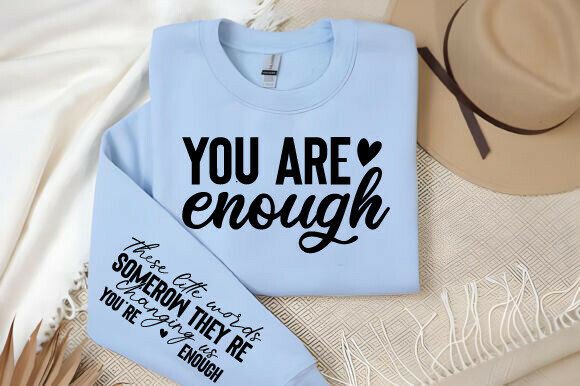
You Are Enough SVG Self Love, Sleeve PNG
A Quiet Statement That Stitches With Intention
When I opened You Are Enough SVG Self Love, Sleeve PNG for the first time—not to list it, not to resell it, but to stitch it—I paused. Not because of complexity, but because of weight. The phrase “You Are Enough” carries emotional resonance, and this design delivers it without shouting: clean lines, gentle curve in the sleeve layout, soft spacing between letters, and a subtle organic rhythm that feels hand-drawn, not algorithmically spaced. It’s not flashy. It doesn’t beg for attention. But it holds space—exactly where you’d want it on a relaxed-fit sweatshirt cuff, a linen tote bag strap, or the curved hem of a baby kimono.
How It Lives in Real Embroidery Projects
Last week, I used You Are Enough SVG Self Love, Sleeve PNG as the centerpiece for a small-batch run of organic cotton aprons for a local herbalist’s shop. We placed it low on the left sleeve—just above the elbow—so it appeared when arms lifted during mixing or pouring. The result? Customers kept touching it. Not the embroidery itself, but the *idea*: soft satin-stitched lettering with slight tapering on the “Y” and “E”, balanced negative space, and no competing flourishes. That’s the strength of this machine embroidery design—it supports meaning, not noise.
It works especially well on mid-weight fabrics where stitch definition stays crisp: brushed cotton sweatshirts, medium-weave tea towels, twill tote bags, and structured pillow covers. On baby onesies? Yes—but only if hooped carefully and stabilized with lightweight cutaway. The letterforms are generous enough to avoid thread crowding at 3–4 inches wide, but they’re not built for sub-2-inch scaling. I wouldn’t push it onto a toddler cap brim or a tiny patch under 1.5 inches.
Where Caution Meets Craft
This isn’t a “set and forget” embroidery file. Its quiet elegance depends on execution. On dark fabric, I recommend testing thread colors in matte black *and* heather gray—not just for contrast, but for tone. A glossy black thread can read harsh beside the warmth of the message; a charcoal matte gives depth without severity. On stretchy knits (like ribbed cuffs or lounge tees), use a light tear-away + adhesive stabilizer combo—otherwise, the satin stitch edges can ripple subtly, softening legibility.
The design’s minimalism is also its vulnerability: there’s no decorative border, no anchor motif, no secondary element to distract from minor registration shifts. If your hoop slips even 0.5mm during stitching—or if your fabric shifts mid-run—the “Enough” can appear slightly uncentered beneath “You Are.” That’s not a flaw in the file; it’s a reminder that this is a *sleeve* design meant for thoughtful placement, not mass-produced center-chest repeats.
What This Means for Your Craft Business
If you sell on Etsy or at craft fairs, You Are Enough SVG Self Love, Sleeve PNG adds quiet credibility to your brand voice. It signals care—not just in stitching, but in curation. Buyers recognize intentionality. They’ll pay more for an embroidered kitchen towel with this phrase thoughtfully placed near the hanging loop than for the same phrase crammed into a corner with clip-art energy.
For personalized gifts? It shines. A custom embroidered sweatshirt for a friend recovering from burnout, stitched in oatmeal thread on charcoal fleece—this design doesn’t compete with emotion. It holds it. Same goes for nursery decor: stitched on a muslin wall hanging beside a minimalist mobile, it reads as tender, not trite.
Practical Designer Notes Before You Stitch
- Always test on scrap fabric first—especially if using textured weaves (like burlap tea towels) or high-pile fleece. Satin stitch behaves differently across surfaces.
- Check stitch density visually in your embroidery software. This design avoids dense fill areas, but confirm no overlapping satin columns compress into hard ridges.
- Confirm hoop size compatibility. While labeled “Sleeve PNG,” it’s scalable—but don’t assume it fits standard 4×4 hoops at full intended width. Measure your target placement first.
- Inspect corners and terminals. The lowercase “g” and “y” have subtle curves—ensure those aren’t over-trimmed or under-stitched in your test run.
- Try black-and-white mockups before finalizing thread choices. What reads warm in RGB may read cold in thread under natural light.
- Use proper stabilizer—light cutaway for stable wovens, adhesive+tear-away for knits. Skipping stabilization here sacrifices clarity, not just convenience.
- Review licensing before commercial use. Since the product description states “Includes designs” without specifying terms, verify whether resale of finished embroidered products is permitted—and whether digital redistribution (e.g., bundling with other files) is allowed.
Why It Fits T-Shirt Designs—And So Much More
Yes, You Are Enough SVG Self Love, Sleeve PNG falls under T-Shirt Designs and Graphics—but reducing it to that category undersells it. Its sleeve-specific layout invites movement: it’s meant to be seen mid-gesture, not static on a chest. That makes it ideal for apparel decorators building cohesive collections (think matching parent-child sweatshirts, or staff aprons for wellness studios). It also translates beautifully to non-apparel uses: as a subtle embroidered patch on a denim jacket pocket, stitched onto the fold of a handmade blanket, or even digitized as a single-line running stitch for delicate silk scarves.
Ultimately, this isn’t just another digital embroidery file. It’s a design asset with emotional precision. It won’t dominate a boutique shelf—but it will linger in memory. And in handmade product markets, that kind of resonance is what turns one-time buyers into repeat customers, and crafters into trusted voices.